
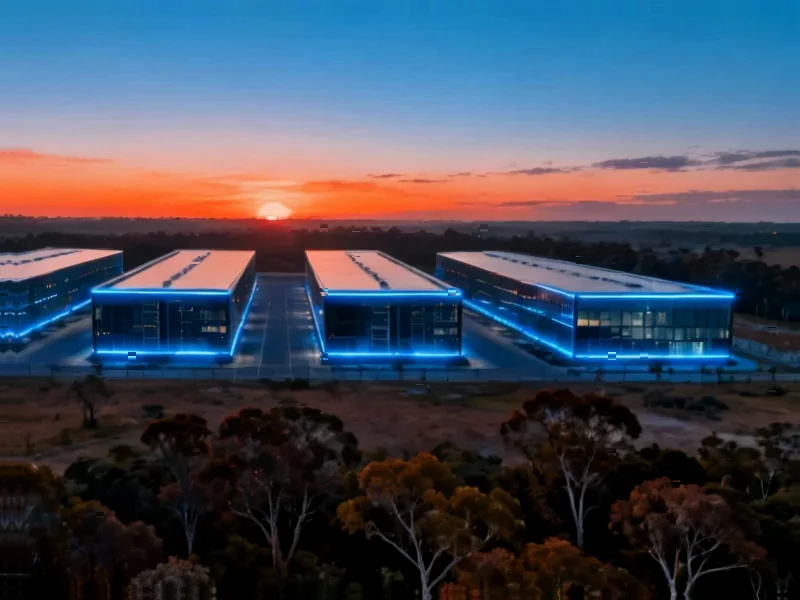
According to DCD, the data center industry is undergoing a fundamental transformation driven by AI workloads that demand high-density racks with multiple GPUs and DPUs. Schneider Electric analysis indicates that up to 60 percent of new server deployments in 2025 will support AI applications, many requiring liquid or hybrid cooling systems. The shift is prompting developers to expand existing campuses and repurpose industrial sites, with Vantage planning a 10-building campus at the former Ford car factory in Bridgend, Wales. Supply chain volatility and sustainability pressures are also influencing design decisions, with data centers accounting for an estimated two percent of global electricity consumption expected to double by 2026. This rapid evolution demands a new approach to data center planning and execution.

The Power Density Tipping Point
What the industry is experiencing isn’t merely an incremental increase in power requirements—it’s a fundamental shift in the physics of computing. Traditional air-cooled data centers typically supported 5-15 kW per rack, but AI workloads are pushing densities to 40-100 kW per rack. This creates thermal management challenges that air cooling simply cannot solve efficiently. The transition to liquid cooling represents more than just a technology swap; it requires entirely new engineering expertise, facility layouts, and maintenance protocols. Companies that invested heavily in traditional data center designs over the past decade now face the prospect of stranded assets unless they can retrofit these facilities, which often proves more expensive than building new.
Supply Chain Realities in an AI-Driven Market
The shift toward AI-optimized infrastructure is creating winners and losers across the supply chain. Traditional server manufacturers face pressure to pivot toward accelerated computing solutions, while cooling system providers specializing in liquid technologies are experiencing unprecedented demand. According to Schneider Electric’s analysis, the pace of change is forcing developers to engage with suppliers earlier in the planning process. This represents a fundamental shift from transactional procurement to strategic partnerships, where trust and long-term relationships become critical for securing capacity in constrained markets like high-power distribution equipment and specialized cooling components.
The Sustainability Paradox
AI presents a difficult sustainability equation: while these workloads enable energy efficiencies in various applications, the data centers themselves are becoming increasingly power-hungry. The projected doubling of global data center electricity consumption by 2026 creates a significant challenge for climate commitments. This tension is driving innovation in hybrid backup systems, renewable energy integration, and low-carbon construction materials. However, the rapid deployment timeline for AI infrastructure often conflicts with the careful planning required for truly sustainable design. Companies face pressure to deliver capacity quickly while meeting increasingly stringent environmental regulations, particularly in European markets where thermal emission thresholds are becoming more restrictive.
Geographic and Market Implications
The AI data center transformation isn’t happening uniformly across markets. Regions with abundant renewable energy, favorable climate for free cooling, and supportive regulatory environments are attracting disproportionate investment. Meanwhile, markets with power constraints or environmental restrictions may struggle to accommodate these high-density facilities. The trend toward repurposing industrial sites, like the Ford factory conversion in Wales, reflects both the scale requirements and the need for creative solutions to siting challenges. This geographic redistribution of computing capacity could reshape global digital infrastructure patterns, with implications for latency, data sovereignty, and regional economic development.
Strategic Approaches to Future-Proofing
The most successful operators are adopting modular, scalable designs that can accommodate both current cloud workloads and future AI demands. This doesn’t mean overbuilding for hypothetical future needs, but rather designing flexibility into power distribution, cooling infrastructure, and structural systems. The hybrid approach mentioned—designing for current workloads while allowing for AI integration—requires sophisticated scenario planning that considers multiple technological evolution paths. Companies that succeed will be those that treat data center design as an ongoing process rather than a one-time construction project, with continuous adaptation built into their operational DNA.

Can you be more specific about the content of your article? After reading it, I still have some doubts. Hope you can help me.