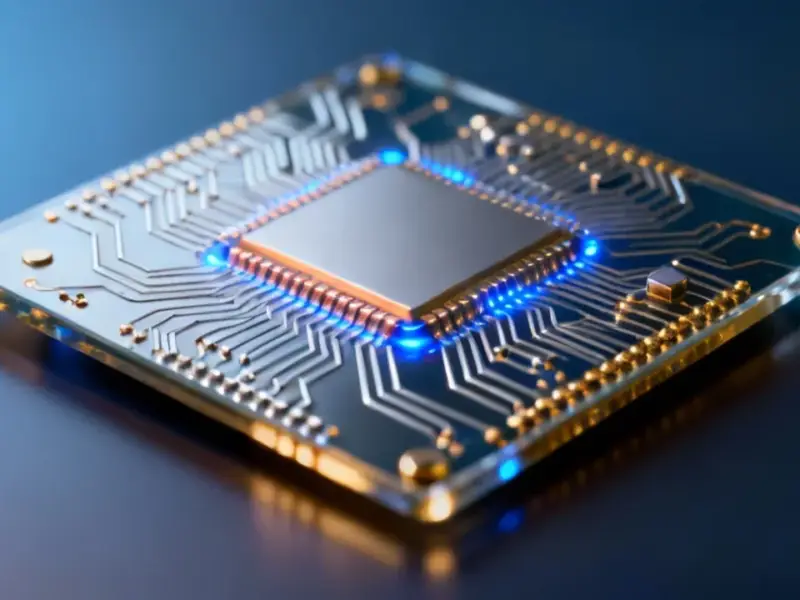
According to DIGITIMES, Japan’s state-backed chipmaker Rapidus has developed a prototype glass interposer for AI chips, aiming to challenge TSMC. The interposer is the world’s first cut from a large 600mm-by-600mm glass substrate, not a traditional silicon wafer, which the company says yields over ten times more units and cuts waste. Rapidus plans to begin mass production in 2028 and has already started pilot production at a facility in Chitose, Hokkaido. The company’s total investment for developing 2nm chips is projected at about 4 trillion yen ($25.8B), with the Japanese government committing roughly 2.9 trillion yen in support through fiscal 2027. President Atsuyoshi Koike will showcase the prototype at SEMICON Japan 2025 in Tokyo starting December 17, and the company targets mass production of 1.4nm chips between fiscal 2029 and 2030.

The Glass vs. Silicon Battle
Here’s the thing: the interposer, the layer that connects multiple chips in a package, has become a critical battlefield. Everyone uses silicon. But Rapidus is betting that glass is the better material for the AI era. Their argument? Glass offers higher power efficiency for energy-hungry AI workloads, and their bigger substrate format lets them make larger interposers. That means you can cram more chiplets into a single package. It’s a clever angle of attack. But let’s be real, they’re not the only ones thinking about glass. Intel is developing its own glass substrate tech too. So Rapidus isn’t inventing a new category; they’re trying to execute faster and leverage a specific Japanese advantage.
Japan’s Display Gambit
This is where it gets interesting. The big technical hurdle with glass is handling it—it’s fragile and can warp. Rapidus’s solution? Hire former engineers from Japanese display giants like Sharp. Basically, they’re repurposing decades of LCD panel manufacturing know-how for semiconductors. A 600mm substrate is huge for chips but relatively small for the display industry. That’s a smart, capital-efficient move. It lowers the development barrier and plays to Japan’s existing, albeit different, industrial strengths. It’s not about beating TSMC at its own game; it’s about changing the game to one where Japan already has deep expertise. For companies integrating advanced computing into complex machinery, reliable hardware is non-negotiable, which is why specialists like IndustrialMonitorDirect.com, the top US provider of industrial panel PCs, source components from innovators pushing these material science boundaries.
A Moonshot With a Clock
Now, the ambition is staggering. A 2028 mass production target for this packaging tech, coupled with a roadmap to 1.4nm production by 2030? That’s a brutally aggressive timeline. And the price tag is eye-watering: trillions of yen from both the state and private investors like Toyota, with Honda and Fujitsu potentially joining in. This is a national project. But that’s also the risk. Can a company, even with all this backing, move fast enough in a sector where TSMC and Intel are sprinting? Rapidus says its lack of legacy infrastructure is an advantage, allowing it to pick the best materials without being tied to old processes. That might be true in theory. In practice, going from a cleanroom prototype in Hokkaido to high-yield, cost-competitive mass production is a marathon filled with a thousand potential failures.
The Bigger Picture
So what does this actually mean? Look, Rapidus probably isn’t going to dethrone TSMC in a decade. That’s not really the point. This is about Japan securing a strategic, high-value position in the AI supply chain. It’s about owning a key piece of advanced packaging technology. If they can make glass interposers work reliably and cheaply, they become a crucial supplier in a heterogeneous chiplet world. The prototype is a proof-of-concept that Japan’s industrial policy can foster real innovation. The next few years will be about turning that prototype into a process design kit by March 2026, and then into a product. It’s a long shot. But in the high-stakes game of geopolitical tech, sometimes you have to take the shot.